Last updated: November 5, 2026 · by LINK-SHINE SMART TECHNOLOGY LTD
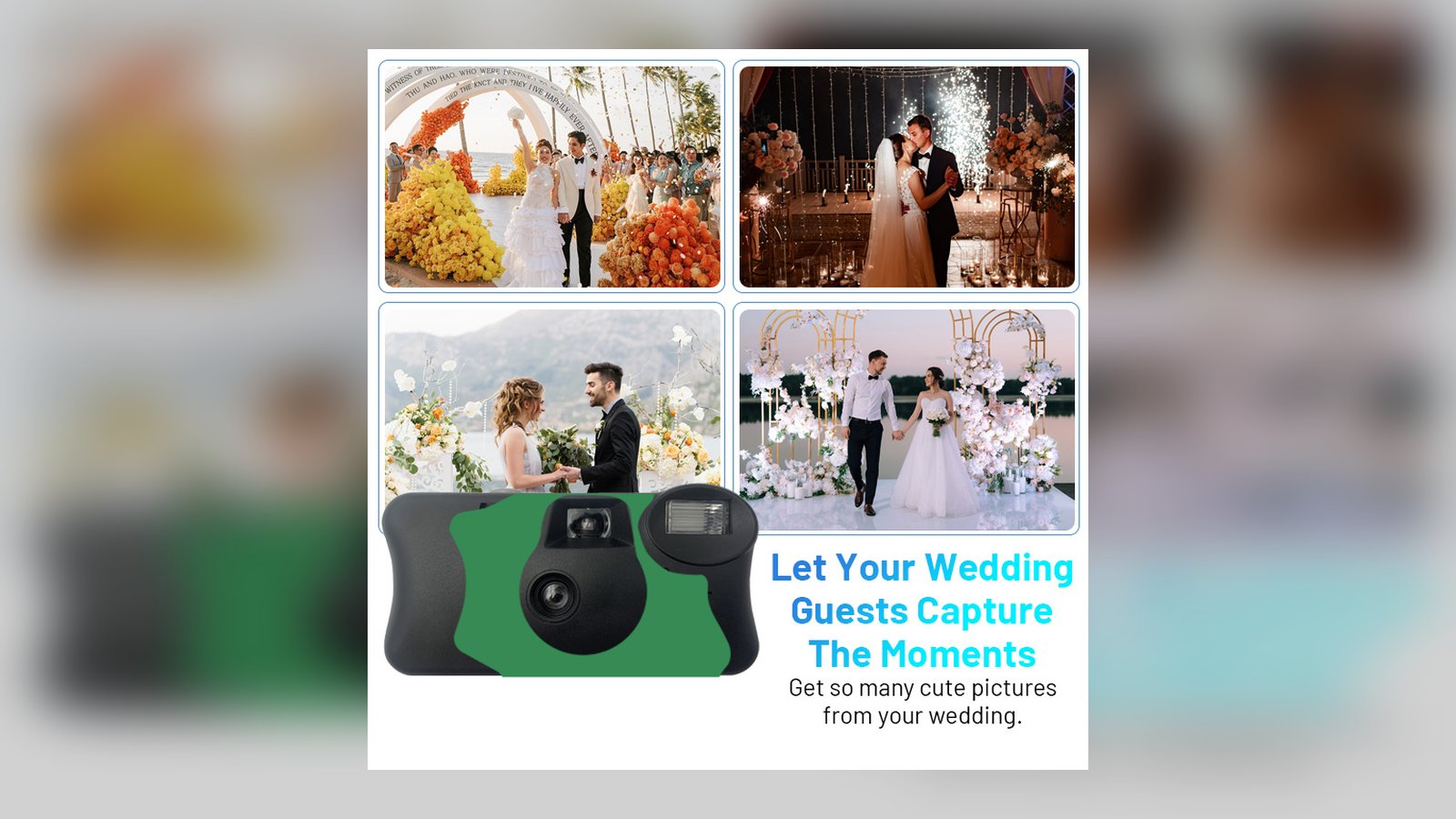
“We were going to do Polaroids, but then someone said disposable cameras are cheaper.” We hear that more than once a week, usually from a wedding planner or a brand team who has already booked a venue. The decision usually gets made in a group chat, and the arguments are always the same three: guest experience, cost per photo, and what people take home.
So here is the honest breakdown, including the parts where instant cameras genuinely win. A disposable film camera and a Polaroid-style instant camera are not competing products — they hand out different experiences, and picking the wrong one means the camera tables look great on the day and quietly disappoint afterwards.
The comparison that actually matters
| Disposable film camera | Instant (Polaroid-style) camera | |
|---|---|---|
| Photos per camera | Fixed by the model: 8 / 12 / 17 / 24 / 27 / 36 exposures | A film cartridge, typically around 10 shots, loaded by the guest |
| Guest experience | Pick up and shoot, zero instructions | Pick up, aim, wait for the photo to develop in hand |
| Photo in hand at the venue | No — negatives come back to you, then get developed and scanned | Yes — a physical print appears within a minute |
| Copies | One negative per shot; we scan it, you get a digital file | One physical print per shot; sharing means photocopying or photographing the print |
| Immediate social sharing | The shot exists on film until developed, usually days later | The print can be photographed and posted immediately |
| Guest takeaway | The camera itself (plus photos later) | The printed photo (plus the camera if it’s a favour) |
| Unit cost direction | Lower per shot at volume; cameras are the favour | Higher per shot; film is the consumable |
| Customisation depth | Logo on body, shell colour, sleeves/stickers, printed inner box, manual, retail packaging | Logo and packaging are possible; body colour and shell changes are far more limited |
| Failure modes | Film jams and double exposures are rare but real; flash battery is built in and shelf-life managed | Film cartridges can over-expose in heat, and half-used cartridges get thrown away |
| Typical MOQ with us | Wedding and event custom projects from 20 pieces | Not our product line — we sell film cameras, not instant cameras |
That last row is the honesty check on this whole article. We manufacture disposable and reusable film cameras. We are not going to pretend instant cameras are a worse technology to sell you ours — they solve a different problem, and weddings use both every single weekend.
When instant cameras genuinely win
The case for Polaroid-style cameras is mostly about the moment. A guest takes a photo and a physical print slides out of the camera in front of them. They write something on the white border, stick it on the guestbook table, and it is part of the room for the rest of the evening. That is a live, interactive experience, and a disposable camera cannot replicate it. No amount of “we’ll scan the negatives and email them” matches a photo you can hold one minute after the shutter clicks.
So instant cameras earn their place when:
- The couple wants the guestbook table to collect physical, signed prints during the event itself.
- Photos need to appear on social media during the evening, not the following week.
- The budget allows for a smaller quantity of higher-per-shot-cost cameras, one per guest or per pair.
- The couple likes the retro, analog ritual of watching a photo develop.
One production caveat we have learned from years of this line. Instant film is temperature-sensitive and dated. Cartridges bought too far ahead, or stored in a hot car on the way to an outdoor wedding, produce blank or washed-out prints. The failure rate is not dramatic — but when it happens, it happens on the day, in front of guests, and nobody can fix it mid-event. If your instant plan involves buying film in bulk three months early, store it properly or accept that some cartridges will not perform.
When disposable film cameras win
Disposable film cameras win on volume and on what people take home.
One disposable camera covers 8 to 36 shots depending on the model you choose — most wedding buyers land on 27 — and it sits on a table for the whole evening. Guests photograph the speeches, the dance floor, the food, and each other, without asking anyone how it works. Nothing loads. Nothing develops. Nothing runs out mid-reception.
The takeaway is different too. With an instant camera, the guest walks away with a print and the camera goes back to the couple or gets passed to the next table. With a disposable, the guest walks away with the camera, and the photos arrive later — scanned from the negatives, which means the couple gets a digital set of every shot, not just the ones guests chose to keep.
That last point is underrated. Instant photos disappear into pockets, guestbooks and smartphone cameras photographing the print. Disposable camera film comes back to us or your lab as a complete roll, and every frame gets scanned — including the slightly blurry one of the cake that actually made people laugh.
For planners the practical differences:
- Cost per shot: lower with disposables at wedding volume, which usually means more cameras and more coverage.
- Customisation: logos, shell colour, printed boxes, manuals, retail-ready packaging — the full private-label stack, from 20 pieces for wedding and event projects. Instant cameras cannot be customised to that depth at that volume.
- Planning simplicity: one order, one delivery window, one quality standard. Instant film means buying cameras, buying film separately, and managing two supply chains.
- Quantity maths: one disposable camera per 4 to 6 guests is the working rule of thumb, which for a 100-guest wedding lands around 15 to 25 cameras. If you are considering one instant camera per guest, that is 100 cameras plus 100 film cartridges.
If you are still sizing the order, our wedding quantity guide works through the headcount maths, and the event-type planning guide breaks it down by occasion.
What people actually take home
This is the part of the decision nobody puts in the spreadsheet.
A disposable camera handed out at a wedding becomes an object. Guests photograph the venue with it, then photograph each other holding the camera. It gets carried to the after-party, photographed again, and a fair number of them walk out of the venue in a coat pocket — that is normal, and we tell buyers to order 10 to 20 percent more than the strict count to cover it.
A printed instant photo is a memory, but it is also a piece of paper. It gets written on, stuck in a book, pinned to a board, and eventually goes in a drawer. Two months later it is half-forgotten, and nobody can add a copy of it to the couple’s album without photographing it first.
Disposable cameras, by contrast, hand the couple a full digital archive. We develop and scan the negatives as a batch, which means every table, every toast, every candid moment from every camera arrives as files the couple can edit, share and print. The cameras themselves become the physical favour; the photos become the digital record.
Neither option loses. They just deposit the memory in different places, and the choice between them is really a choice about what the couple wants at the end of it all.
What actually gets customized
The customisation question comes up in nearly every wedding enquiry, so here is what is actually possible on each format.
Disposable film cameras take the full private-label stack: logo printing on the body (spray, UV or laser), shell colour changes, custom stickers or sleeves, printed inner colour boxes, custom manuals, barcodes and retail-ready packaging. Wedding and event projects start from 20 pieces. Non-customized samples ship in 1–3 working days; customized samples take longer because artwork has to be prepared and proofed; bulk production runs 10–15 working days after approval.
Instant cameras are customised mostly through the film, the cartridge packaging and the camera wrapping — logo printing on the camera body is possible but shell colour and structural changes are limited, because the instant camera format is dominated by a handful of manufacturers with fixed tooling. If your brand identity depends on the camera itself carrying your name, the film camera route is the one that delivers it.
The cost conversation, honestly
People ask us to compare costs, and we will, but not with a number.
Disposable cameras are quoted per unit with the decoration and packaging folded in. Instant cameras are quoted per camera plus per film cartridge, and the cartridge is the consumable that never ends — every guest, every table, every hour on the dance floor burns cartridge. If the instant plan is one camera per guest for a 150-guest wedding, the film volume is large and the per-shot cost never settles.
We deliberately do not publish prices on any page. Camera pricing moves with order size, decoration, packaging and certification scope, and a published list price would be wrong within a week. Contact us with your quantity and customisation and we will quote against that, in EXW, FOB, CIF or DDP terms — FOB Shenzhen is our default.
If the cameras will carry your brand, the disposable vs reusable comparison is the right place to start, because the format decision comes before the branding decision.
Common questions
Are disposable cameras better than Polaroids for a wedding?
They are not “better” — they hand out different experiences. Instant cameras give guests a physical photo in hand within a minute and keep the guestbook table busy. Disposable film cameras cover more shots at lower cost per shot, carry full customisation, and hand the couple a complete digital archive of every frame. The honest answer is that it depends on whether the couple wants live prints during the event or a full photo archive afterwards.
Can guests get photos immediately with disposable cameras?
No, and that is the one place instant cameras genuinely win. Disposable cameras shoot film; the negatives are developed and scanned after the event, usually within days. The couple receives digital files of every frame. Guests get the photos later, not at the venue.
How many photos does each guest actually get?
With a disposable camera shared at a table, one camera covers roughly 4 to 6 guests over an evening — most models shoot 27 exposures, some compact models 17. With an instant camera, one cartridge typically yields around 10 prints, and the guest who loads it controls how many photos come out of it.
Can I mix disposable cameras and instant cameras at one wedding?
Yes, and couples do it often: instant cameras on the guestbook table for the live-print experience, disposable cameras on the dinner tables for coverage. The disposables are a supply order from us; the instant cameras and their film are a separate purchase, so the two run on separate timelines.
Can I put my logo on both?
Logo printing and custom packaging are available on disposable film cameras as part of the private-label stack — from 20 pieces for wedding and event projects. Instant cameras support logo printing and wrapping, but shell colour and structural customisation are limited by the format’s tooling.
What is the minimum order for wedding disposable cameras?
Wedding and event custom projects start from 20 pieces, including logo printing on the body, custom stickers or sleeves, and printed inner colour boxes with matching retail packaging. Standard programmes run 20 to 100 pieces by model and decoration level.
How far in advance should I order?
Allow 1–3 working days for non-customized samples, longer for customized samples (artwork is prepared and proofed first), and 10–15 working days for bulk production after approval. For a fixed wedding date, ordering three to four weeks ahead leaves room for one revision round and shipping without stress.
What certifications apply to wedding camera orders?
Our range is developed for CE, FCC, RoHS, UKCA and KC market requirements, and certificates are model-specific — tell us the models and the destination market and we confirm which report applies. For the full breakdown of what each mark covers, see our certifications page.
Talk to us about your wedding camera plan
Send us your guest count, your date, and which experience you are leaning towards — the live-print moment or the full photo archive — and we will recommend models and quantity, confirm the customisation, and quote. Samples are ready in 1–3 working days.
Browse disposable film cameras → · Vintage Disposable Camera 35mm with Flash (27 Exposures) · Disposable Camera 35mm with Flash for Weddings & Parties